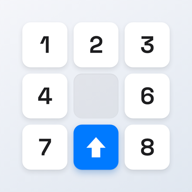
The 3×3 board is the right size to learn slide-puzzle technique on. It is small enough that you can see the whole board at once, but large enough that a real strategy is necessary. Every larger puzzle reduces to a 3×3 endgame, so the time spent here is repaid many times.
This article walks through a complete solution.
The goal
A solved 3×3 puzzle looks like this:
1 2 3
4 5 6
7 8 _
Tiles 1 through 8 in reading order, empty in the bottom-right.
A sample starting position
Imagine you have shuffled and ended up with:
4 1 3
7 2 6
_ 5 8
The empty cell is in the bottom-left. Tiles 4, 1, 3, 7, 2, 6, 5, 8 are scattered.
Step 1 — place tile 1 in the top-left
Tile 1 is currently in position 2 (top middle). We need it in position 1 (top left). That is one slide:
Move the empty from the bottom-left up to position 2 by sliding 7 down, then 2 down, then 1 down — but that moves 1 the wrong way.
Better: route the empty around. Slide 5 left into the bottom-left, then slide 2 down, then slide 1 left into the top-left.
Result:
1 3 _
4 2 6
7 5 8
Tile 1 is placed. (The exact sequence of slides varies; what matters is that 1 ends in position 1.)
Step 2 — place tile 2
Tile 2 needs to be in position 2 (top middle). Currently in position 5 (centre).
Slide 3 right into the empty, slide 2 up into the now-empty centre-top:
1 2 3
4 _ 6
7 5 8
Almost there.
Step 3 — place tile 3 in the top-right corner
This is where the L-shaped corner manoeuvre comes in. Tile 3 is already in position 3 (top right). Good — but normally it would not be that lucky.
If tile 3 had been elsewhere, the technique would be:
- Place tile 2 in the top-right corner instead (temporarily out of position).
- Place tile 3 directly below 2 (in position 6, middle right).
- Rotate the pair clockwise: slide the empty into the top-right (displacing 2), slide 2 left, slide 3 up, slide 2 right.
After this, tiles 2 and 3 are in their correct positions and the top row is locked.
In our luckily-already-placed case, no rotation is needed.
Step 4 — place tile 4 (left column)
Tile 4 is in position 4 (middle-left). It needs to stay there. Currently the board is:
1 2 3
4 _ 6
7 5 8
Tile 4 is already in position 4. Lucky again.
Step 5 — the bottom 2×2
What's left is the bottom-right 2×2 region: tiles 5, 6, 8 plus the empty in the centre. The goal for this region:
5 6
8 _
Currently:
_ 6
5 8
Three moves: slide 5 up, slide 8 left, slide 6 down. Wait — let me re-check.
From:
_ 6
5 8
Slide 5 up into the empty:
5 6
_ 8
Slide 8 left:
5 6
8 _
Done. Two moves.
The fully solved board
1 2 3
4 5 6
7 8 _
Total moves in this walkthrough: about 10. A typical 3×3 takes 15-30 moves with the row-and-column method, depending on the starting position. The hardest possible 3×3 takes 31 moves with an optimal solver — close to what a careful human can achieve.
What you saw
Three things, in order:
- Placing tiles 1, then 2 — direct slides that just bring each tile to the right cell.
- The corner manoeuvre — the trick that places the last tile of a row (and that you would have needed if tile 3 hadn't started already in place).
- The 2×2 endgame — three tiles plus the empty, which is essentially a rotation puzzle.
These three things are the entirety of slide-puzzle technique. Larger boards add more iterations of the same three steps. Nothing else changes.
What to play next
Once a 3×3 takes you 30 seconds, the 4×4 puzzle is the natural step up. The same three techniques apply; you just do them twice — once on the outer layer (top row + left column), once on the inner 3×3 endgame.
If you are teaching a child, the 3×3 picture puzzle is the right starting size; see slide puzzle for kids.
If you came here to verify a solution to a particular board, the only general purpose tool is a software solver — a simple program that returns the optimal sequence in microseconds. Far more interesting than reading a worked example, but worth coming back here when you want to understand why a particular move sequence works.